Eye-Tracking Use for Reading Research

Aims

The main objective was to gather a group of about 20 to 25 ESRs who are interested in knowing how to design and carry out experiments in word reading and reading comprehension using eye-tracking technology.

The main objectives of this Training School included the following:

  • An overview of eye movements and eye-tracking technologies, followed by examples of how they are used to study reading processes and discussions on the eye-reading relationship
  • Introduction to the methodology and issues associated with eye-tracking applications in word reading and reading comprehension research
  • Detailed instruction on software capability and functionality, addressing a number of practical issues in starting eye-tracking research
  • Principles of eye-tracking study design, and best practices and advice for data collection
  • Presentation covering technical aspects of the eye tracker, participant setup, and the use of the tracker software for generating experiments (Experiment Builder)
  • Detailed instruction on data analysis, including the use of data visualisation/analysis software (DataViewer)
  • Sample scripts and practice data

Organizers

Timothy C. Papadopoulos and Irene-Anna Diakidoy

Trainers

  • Timothy C. Papadopoulos (University of Cyprus) Specialised in the study of learning disabilities and their treatment
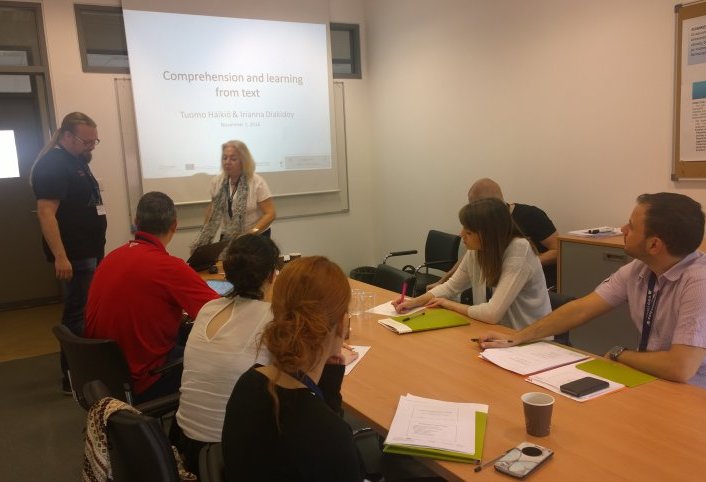
  • Irene-Anna Diakidoy (University of Turku) Specialised in the study of reading development, reading comprehension and learning from text
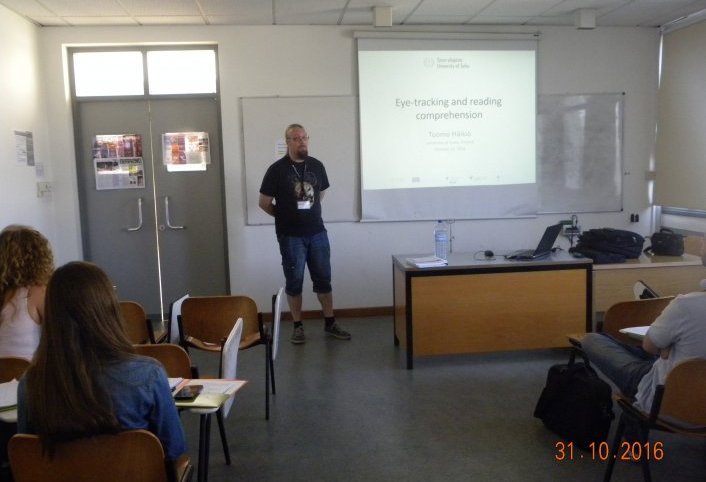
  • Tuomo Häikiö (University of Turku) Specialized in the study of reading development, and the study of word and text processing among elementary school children
  • Christoforos Christoforou (Center for Applied Neuroscience) Specialised on computational methods for neruoscience, EEG, analysis, Brain Computer Interfaces and Information Technology
  • Sam Hutton (Sussex University) Specialised in high speed, high resolution, and eye-tracking equipment
  • Argyro Fella (University of Cyprus) Carrying out experiments with the EyeLink 1000

Program

Monday, october 31

09h30 – 10h15 |  Registration and coffee
10h15 – 10h30 | Welcome
10h30 – 11h30 | Eye-tracking and (word) reading research
11h30 – 12h30 | Eye-tracking and reading comprehension
12h30 – 14h00 | Lunch
14h00 – 15h00 | Introduction to the software for generating experiments (Experiment Builder)
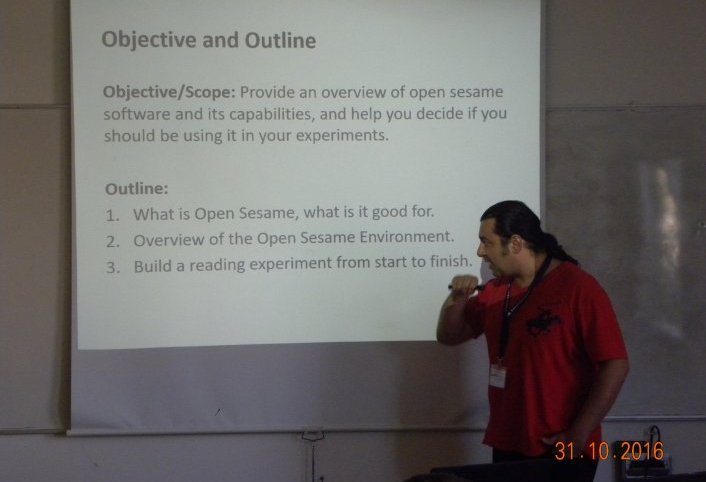
15h00 – 16h00 | Introduction to the software for generating experiments (OpenSesame)
16h00 – 17h00 | Refreshments
16h30 – 18h00 | Introduction to data analysis software (DataViewer)

Tuesday, november 1

09h30 – 10h30 |  Presentation covering technical aspects of the eye tracker, participant setup, and the use of the tracker software – Group 1 / Comprehension and learning from text through eye-tracking – Group 2
10h30 – 11h30 | Presentation covering technical aspects of the eye tracker, participant setup, and the use of the tracker software – Group 2 / Comprehension and learning from text through eye-tracking – Group 1
11h30 – 12h30 | Hands-on practice with the eye-tracker – Group 1 / From eye-gaze recognition and reading: RAN, word reading and ortographic processing – Group 2
12h30 – 14h00 | Lunch
14h00 – 15h00 | Hands-on practice with the eye-tracker – Group 2 / From eye-gaze recognition and reading: RAN, word reading and ortographic processing – Group 1
15h00 – 16h00 | Questions and discuss paradigms
16h00 – 16h30 | Refreshments
19h00 | Training School Dinner

Wednesday, november 2

09h30 – 12h30 |  From the Experiment to the Result file: How to analyze your data
10h15 – 10h30 | Welcome
12h30 – 14h00 | Lunch
14h00 – 15h00 | Q&A session
15h00 – 16h00 | Training School adjourns